|
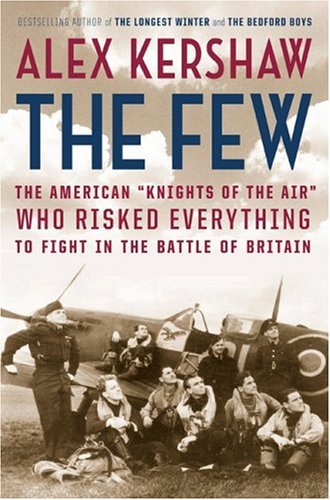
I received this
book as a Christmas gift from a friend, and it didn't take me long to get
into it.
The story begins
in the United States at the very beginning of Worl War II. We look at the
lives of three young men, all very much enthused with aviation. There's a
war on, and all want to fly in it, not just to defeat the Germans, but for
the love of flying itself. Quite a few pages are devoted to the where with
all of these young men getting out of the US, and going through Canada to
get to England. After much to do, they finally get into France, but due to
the chaotic conditions there, do not get to fly, but have to high tail it
out before France falls to the invading Germans. Eventually, they get to
England again, and finally get into Hurricanes just in time to fight in
the Battle of Britain. It must be remembered that at that time, it was
illegal for Americans to join up with any belligerant due to our
neutrality laws, and these men gave up their US citizenship to do so.
A further young
man, William Fiske, a champion bobsledder, joins them, as they are
assigned to different RAF squadrons. The author does a good job of placing
the reader into the cockpit of the Hurris and Spifires. he also tells us
quite a bit about the Luftwaffe pilots that the RAF is fighting daily
aerial duels with. He goes to some length to describe the competition
between Werner Moelders, Adolf Galland, Helmut Wick, and Hans-Karl Mayer.
He also has his Luftwaffe Jagdgeschwaderen
straight, assigning each of the above named experten to the units to which
they belonged. Hermann Goering is also prominently mentioned, as well as
his opulent country home, Karinhall. Various other Luftwaffe
personages get mentioned in their own turn. Don't think that only the
enemy gets mention, but you meet Sholto Douglas, Johnny Johnson, and
Sailor Malan to mention a few. Winston Churchill receives attention, and
several well known phrases from his most notable wartime speeches are
covered.
Toward the end of
the BoB, the Eagle squadron of American fliers in the RAF was formed, and
most of the Americans transferred to it. Remember, once we were in the
war, these same fellows formed the nucleous of the USAAC's 4th Fighter
Group. (The only well known American 4th FG pilot named is Chesley
Peterson) Eventually, 244 US citizens flew in the Eagle squadrons, but
only 7 took part in the Battle of Britain. Of those 244 Americans, one
fourth of them lost their lives.
Alex Kershaw's
writing is somewhat florid with such comments as "Hermann Goering sat
in his personal train, Asia, relaxing after being injected by a Luftwaffe
flunky, Herr Doktor Onzara" and "Goering stepped out of
Asia to be greeted by a sycophantic Kesselring and lackeys carrying picnic
baskets". Such commentary brought me back to my youth, when I used to
read the wartime novels about Dave Dawson in Europe, and Red Randall in
the Pacific, all penned by R. Sydney Bowen, and calculated to excite
the teen aged boy's mind about military aviation, and a not so subtle
hatred of the enemy. In any case, it's a well researched book, and easy to
read through. I can heartily recommend it.
Enjoy,
Hal Marshman Sr
|
|
|