|
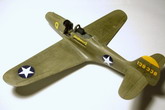
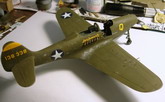
This is my Eduard 1/48 P-39D,
which is actually from the “Airacobra Mk. 1 Dual Combo” kit. The -D
was a little different from the Mk.1, using different exhausts, and having
a slightly different instrument panel. However, these parts are included
in the kit, and there are numerous websites that specify what parts are
used with which version.
I started the build off by sanding the
inner trailing edges of the upper and lower wing halves. This is one of
the only inaccuracies with this kit- the trailing edges look like
they’re about 2 scale inches thick! I managed to sand them to about a ¾”
scale thickness before I got tired of sanding and gave up.
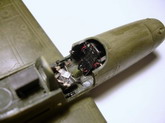
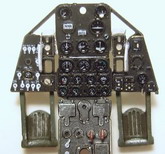
The next step was the cockpit. The Dual
Combo issue of the kit includes a beautiful fret of color photo
etched parts, and the painting/printing on them is fantastic! The larger
gauges and a couple of words on the instrument panel are actually (or seem
to be, anyway,) readable! The panel was folded and assembled as per the
instructions, with the front panels being attached to the rear one with
Future, and then the gauges were given a couple more applications of
Future to simulate the glass and also to help keep the parts attached.
The
aircraft’s two nose gun charging handles are represented by a couple of
photo etched parts that are folded in half to create the handle.
Naturally, I always lose one or two parts
during a build, and this time the carpet monster must’ve really had a
hankering for some photo etched metal. While trying to attach said handles
to the instrument panel, I somehow managed to drop one of them onto the
floor. After almost two hours of looking for it, I finally gave up. Fortunately, I still had the other handle to make a styrene replacement.
But then, it too was lost, though I have no idea how or when. However,
just when it seemed that all hope was lost, Wing_nut on the Finescale.com
forums came to the rescue. He said that he had the parts and could send
them to me. After a couple days waiting for them to come in the mail, they
finally arrived, and the project was back on track. (Photo 03 shows the
panel with the styrene replacements I had originally installed, photo 05
shows the photoetched versions, as well as the IP rear part and gunsight.)
Click on
images below to see larger images
|
|
|

|
|

|
|

|
|
Photo 3 |
|
Photo 4 |
|
Photo 5 |
|
Photo 6 |
The
rest of the cockpit went together well, with only the rudder and aileron
trim knobs, the fuel tank selector switch, the upper part of the gunsight,
and the rear of the instrument panel added from styrene. The cockpit area
was painted with a mixed paint that I later discovered is very close to
Model Master RAF Dk. Green, just a hint darker and less green than the
Model Master
color. Adding a little black to the Model Master green will get almost the same
color. The details were picked out in black, and the seat was also painted
black. A small rod was added in the space in the rear bulkhead, and the
photoetched seatbelts were draped over it to match reference photos.
After the cockpit was
finished, I assembled the gear bays, and then the fuselage and wings were
assembled. Here was where I ran into my first fit problem. By sanding the
wings, I must’ve messed up the fit somehow, because there was a large (a
little less than 1/16”) gap at the wing root. After filling this with
Squadron white putty, I thought I was done, but when handling the model, I
accidentally cracked the putty. I was then stuck with a choice: remove the
wings and redo the assembly/filling, or try to refill the gaps and risk
the wings not bonding right and have the same thing happen again. I chose
the latter, and solved the bonding problem by mixing Squadron white with a
little liquid cement to improve adhesion. The seam isn’t as good as I
would’ve liked, but it’ll do. Plus, I found a way to help cover it up,
which I'll describe later.
Next, the model was painted
with Model Master enamels- Olive Drab ANA 613 for the upper surfaces, and
Neutral Gray for the bottom. The OD did something I’ve never seen
before. It dried with several areas having a different sheen/color that
looked better than any fading I could have done. (VERY) Unfortunately,
this effect disappeared after I added the final clear coat.
The decals were from
Aero master’s “Aircobras (note the typo) At War Part III” sheet. Since
they were aftermarket decals, I figured that they would be good quality, but no
matter how much Micro Sol I applied or how many times I applied it, they
wouldn’t even show the smallest sign that the Sol was working. And to top it
off, they silvered a little bit after I added the clear coat. I was able to fix
this a little bit by slicing them repeatedly with a sharp hobby knife and then
applying some Sol followed by some Future diluted with water. The yellow tail
tip and spinner were hand painted with some Testors flat yellow with a little
red mixed in to match the decals. After decals the last few bits were added like
the landing gear and machine guns. The nose cannon and machine guns were drilled
out and painted with MM Metalizer Burnt Metal. The exhausts were also painted
with this color followed by brown and rust-colored watercolor paint washes.
The wing seams were
hidden by adding some paint wear/chipping with MM burnt metal mixed with Floquil
old silver, and the model was weathered with watercolors. A few months later I
also added better exhaust streaks and some smoke/cordite stains on the wings
with pastel chalks. (the weathering doesn’t look as pronounced in the photos
as it does in person, either.)
Overall, this was a
very satisfying build, and though a couple of things could have gone better, it
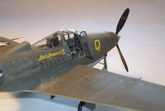
was worth the time and effort I put into it. (Photo 16 shows a little bit of the
other kit from the dual combo, done as P-400 “the Flaming Arrow” from the
same decal sheet.)
*One last note: in
the two shows I have entered this kit, it won the special award “Best 1942
Pacific Theater” at the 2007 IPMS Seattle Spring Show, as well as “Best
Junior Model” at the NOPMS show.*
Josh
Click on
images below to see larger images
|

|
|

|
|
|
|
Photo 16 |
|
|