|
Sometimes
referred to simply as a swept wing Vampire or “Son of Vampire”, the
DH112 Venom actually shared remarkably few parts with it’s predecessor.
The
Vampire of course first flew in 1943, very much the contemporary of the Meteor,
although destined not to enter service until 1946.
At about the same time, the RAF announced that the Meteor was to
be it’s standard clear weather day fighter.
This resulted in the majority of Vampires being delivered to RAF
squadrons with the 2nd TAF in Germany for use in the ground attack
role.
Seeing
this, De Havilland decided that they could improve upon the ground
attack performance of the Vampire & began work on what was originally
known as the Vampire FB8.
To
increase power, the new DH Ghost engine replaced the Goblin.
This engine could easily be accommodated in the Vampire’s
fuselage “pod” with little modification.
The
wing was considerably thinner than the Vampire to reduce drag (in much
the same was as the Tempest began life as a “thin winged” Typhoon).
This thinner wing required a new undercarriage with far thinner wheels.
In addition, the wing was strengthened to carry bombs of up to 1000lbs or
drop tanks, rockets & in a first for a UK aircraft, jetisonable wingtip fuel
tanks.
The
major problem was a result of the increased weight of the Ghost engine,
which completely destroyed the aircraft’s centre of gravity.
Unable to compensate by moving the engine forward or the wing aft, the De
Havilland designers discovered that by introducing a modest sweep of the
wing leading edge & straightening the trailing edge, the centre of pressure
was moved sufficiently aft to compensate.
All
these changes made the design sufficiently different to warrant a new reference
– DH112 - & name; Venom was selected (Valkyrie having also
been considered).
|
Click on
images below to see larger images
|
|

|

|
|
On
entering service the Venom FB1 began replacing the Vampire in RAF
squadrons in Germany, the middle & Far East.
Service entry was marred by a number of fatal accidents involving mid air
fires, the cause of which was not located until a particularly brace pilot,
ignoring standing orders to abandon the Venom under such circumstances,
managed to land, jump out & tackle the blaze himself with an extinguisher!
Further fatalities were the result of catastrophic wing failure when
pulling out of a dive. The cause
was swiftly diagnosed as structural failure around the "cut-out" of
the main wheel bays. A fleet wide
strengthening programme was put in place but aircraft awaiting modification had
broad red bands painted around their wings, indicating a 3g limit.
Rather unnerving for the pilots I expect!!
The
FB1 was soon joined by the FB4, which introduced powered controls & tropical
equipment along with redesigned tail fins.
Although
intended as a ground attacker, the Venom possessed many attributes that
made it a fairly reasonable dog fighter. It
was more manoeuvrable than both the Meteor & Sabre (RAF pilots
reported that the Venom was all over the Sabre “like a tent” in a turning
fight). It also had a ceiling of
48000 ft. & was often used to simulate attacking Soviet bombers on exercises
for the RAF’s Meteor & Sabre home defence squadrons; worryingly, even the
Sabre F4 was unable to reach this kind of altitude!
In
addition to it’s service as a single seat ground attack fighter, the Venom
also served in twin seat form as a nightfighter, but that’s another story.
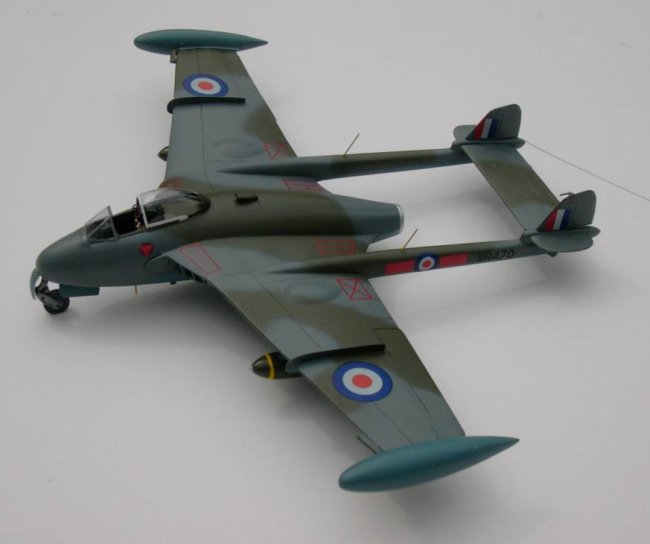
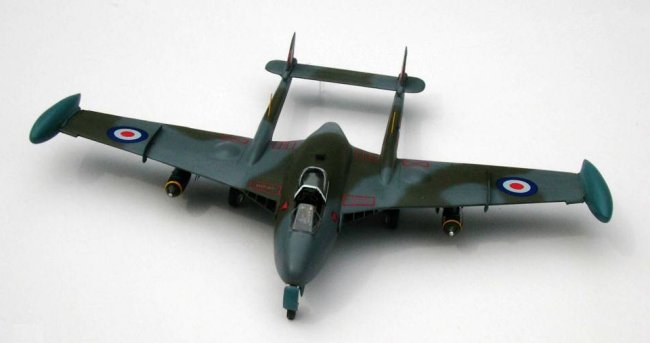
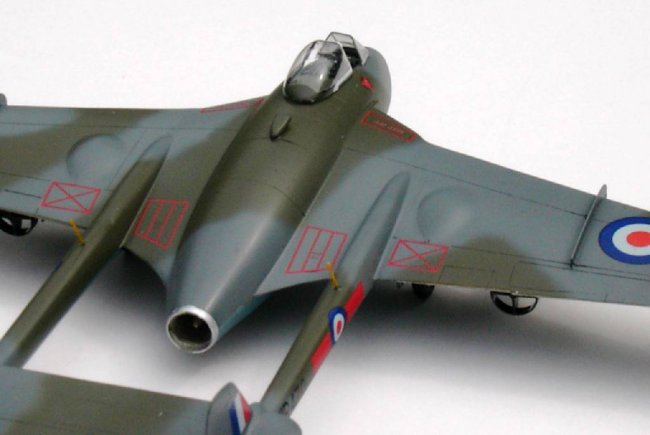
The
Aeroclub kit is superb. The
centre section & wings are on two vacform sheets with all other airframe
parts (booms, tail plane, front fuselage) being injected & white metal for
all the detail parts. This was my first ever vacform & accordingly, I
removed slightly too much material around the intakes which necessitated a fair
amount of packing & filling & rescribing at a later stage.
Lots
of detail is provided for the cockpit, including a white metal seat.
Being too clever for my own good, I decided to replace this with a Cutting
Edge seat, only to find out at the final stages that the white metal seat
would have provided the required nose weight, leaving me with a tail-sitter!
No
ordnance is supplied with the kit but I loaded a pair of Cutting Edge RAF
1000lb bombs, scratch building the pylons to suit.
Markings
are from the kit for a 5 Squadron machine; you also get those for a 266 Squadron
machine. The Aeroclub FB1
offers another couple of units & there are a couple of Xtradecal
sheets, intended for the Hobbycraft DH Vampire so although I haven’t
specifically checked, it should be possible to produce representative machines
from many other units as often they progressed from Vampire to Venom FB1 to
Venom FB4.
All
in all, a pleasant introduction to vac form modelling.
On the strength of this, I have added Aeroclub’s Venom
FB1, NF3 & Sea Venom to the stash, along with their Meteor NF14
& superb Canberra! If
RAF jets of the 1950’s “float your boat” as they do mine, Aeroclub
are the way to go.
References:
-
The
DeHavilland Venom, & Sea Venom, The Complete History
by David Watkins
-
The
DeHavilland Venom Warpaint No. 44
-
Jet
Jockeys, Flying the RAF’s First Jet Fighters by
Peter Cayhill
Graham
|