|
|||||||||||||||||||||
|
|
|||||||||||||||||||||
|
|
|
||||||||||||||||||||||||||||||||||||||||
|
History The P-47 was an outstanding escort and ground attack aircraft and was the heaviest and largest single seat fighter built during WWII. It rose out of a humble beginning which saw use by U.S., British, French, Mexican, Brazilian, Chinese and Russian air forces. ETO: The Eighth Air Force was established on February 1, 1942, with responsibilities in the northern European war zone. The Eighth switched from the plane-in-group numbering system to the use of the same coding system of the R.A.F.; 2 Squadron characters and an aircraft letter flanking the national insignia (I.E., "E2 A" 361st FG 375th FS aircraft "A"). Initial color of the codes was grey, then white, when all aluminum aircraft appeared, they were black. Night Fighters didn’t have codes. When there were to many aircraft in a unit and not enough letters, a horizontal code was drawn under the aircraft code for identification. The first fighter used by the Eighth was the British Spitfire with U.S. markings. This was followed by the first U.S. type, the P-38. However, it didn’t engage the Luftwaffe in combat and were sent to North Africa. The P-47C was the first U.S. made aircraft to do battle in Europe, in April 1943. It was the only single seat fighter with an air-cooled engine, along with the Fw-190A, in Europe. To better identify the P-47, before entering combat; a) the national insignia on the underside was enlarged and placed on both wings, b) front 24 inches of the cowling were painted white, c) 12-inch stripe was added to the vertical stabilizer, d) 15-inch-wide stripe was added to the horizontal stabilizer, later black on unpainted aircraft. Stripes fell out of use in late ‘44’ and by 1945 only a few units had them. By the end all fighter units of the 8th had Mustangs, except the famed 56th FG. Eighth Air Force headquarters was reassigned to Sakugawa (Kadena Airfield), Okinawa, on July 16, 1945, being assigned to the United States Strategic Air Forces in the Pacific without personnel or equipment. The atomic bombings of Japan led to the Japanese surrender before Eighth Air Force saw action in the Pacific theater. Eighth Air Force remained in Okinawa until June 17, 1946, having received its first B-29’s on August 8th 1945. MTO: The Ninth Air Force was originally the V Air Support Command activated on September 1, 1941. War came upon us and it was redesignated the Ninth Air Force in April 1942. Posted to Egypt, the Ninth began operations on November 12, 1942. It participated in the Allied drive across Egypt and Libya, the campaign in Tunisia, and the invasions of Sicily and Italy. In October of 1943 it was transferred to the ETO to become the tactical air force for the invasion of the continent. The Twelfth Air Force was activated at Bolling Field in August 1942, and in September placed under the command of General Doolittle, barely four months after it was conceived, 12th AF made its first contributions to World War II. When D-Day for the invasion of North Africa (Operation Torch) occurred on 8 November 1942. Initially, 12th AF was a composite organization containing both strategic heavy bombardment groups; and tactical light and medium bombardment, fighter-bomber, and fighter groups. Based in French Morocco and Algeria after Operation Torch, it became very important for 12th AF to coordinate and cooperate with the Royal Air Force which had been fighting the Axis for 2 years. On 22 August 1943, the Ninth Air Force's 12th and 340th Bombardment Groups, and its 57th, 79th, and 324th Fighter Groups were transferred to the 12th AF in North Africa. As the U.S. tactical air force in the Mediterranean, the 12th AF primarily provided close tactical support to U.S. ground forces in Italy and Southern France and targeted lines of transportation and communication, particularly roads, railroads, and bridges until the end of the war. 12th AF operated in the Mediterranean, French Morocco,
Algeria, Tunisia, Greece, Italy, Southern France,
Yugoslavia, Albania, Romania, and Austria. 12th AF P-47 units were: 27th FG (552nd, 523rd, 524th FS), 57th FG (64th, 65th, 66th FS), 79th FG (85, 86, 87 FS), 86th FG (525th, 526th, 527th FS), 324th FG (314th, 315th, 316th FS), 350th FG (345th, 346th, 347th FS) PTO: The Seventh Air Force initially provided air defense for the Hawaiian Islands. It also became the hub of the Pacific aerial network. In addition to Depot functions, it supported the 4-engine all-weather transport used in ferrying troops, supplies, and evacuating wounded from forward areas. These transport planes were under the command of Pacific Division, Air Transport Command. The command also played a major role throughout the Pacific War as a training, staging, and supply-center for air and ground troops. The command deployed most of its combat units to the Central Pacific, where operations were best summed up by its air and ground views as "Just one damned island after another!" Seventh Air Force units deployed 2,000 miles southwest to the Gilbert Islands, then 600 miles northwest to the Marshall Islands, 900 miles west to the Caroline Islands, 600 miles northwest to the Mariana Islands, 600 miles north to Iwo Jima, 1,000 miles west to Okinawa, always edging closer towards the center of Japanese power. A map story of the Seventh Air Force would cover 3,000 miles north and south of Midway Atoll to Fiji, and 5,000 miles east and west from Pearl Harbor to the Ryukus. Early 1944 the 318th was equipped with Republic P-47D Thunderbolts, while still stationed in Hawaii. On June 22nd and 23rd, from the escort carrier USS Natoma Bay, the 318th catapulted 37 P-47’s landing at Aslito airfield. During the Marianas campaign, it worked closely with Marine ground forces, pioneering close infantry support and employing the first use of napalm. On Saipan the 318th had the dubious distinction, along with the 21st Fighter Group on Iwo Jima, of being the only Army Air Force units to engage in ground combat. The squadrons of the 318th Fighter Group were attacked by Japanese ground forces in June 1944 on Aslito Airfield, Saipan (renamed Isley Field), sustaining modest casualties. From November 1944 to January 1945, the 318th Fighter Group helped counter the Japanese air attacks on the Mariana Islands. The 318th was the first unit to receive the new long-range P-47Ns in early 1945 before moving to Okinawa on Ie Shima. During the summer of 1945, the 318th Fighter Group (along with the 15th and 21st from the VII Fighter Command) was reassigned to the Twentieth Air Force and continued its fighter sweeps against Japanese airfields and other targets, in addition to flying long-range B-29 escort missions to Japanese cities, until the end of the war. On 13 August 1945, the 318th flew 1,680 statute miles (2,700 km) from le Shima to Tokyo and back, an 8½ hour non-stop flight. The 318th Group was officially credited with 164 air combat victories by 15 August cease fire, with less than 6 pilots shot down by enemy planes. The 318th was assigned to Eighth Air Force in August 1945, shortly after V-J Day. Moved to the US, December 1945 – January 1946. Inactivated on 12 January 1946. After the war, it was redesignated the 102nd Fighter Group in May 1946. Seventh AF P-47 units were: 15th FG (45th, 47th, 78th FS), converting to P-51. 318th FG (19th, 73rd, 333rd FS), 508th FG (466th, 467th, 468th FS)
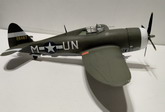
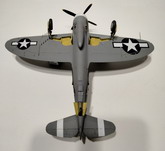
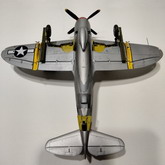
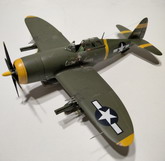
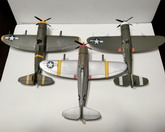
All models built up well, each has its own building points Aircraft Note: After the block number, Evansville aircraft were identified by the -RE suffix, while Farmingdale aircraft were given the -RA suffix. ETO: Aircraft: "Spirit of Atlantic City N.J.", P-47D-5, (42-8487) – Shot down March 27, 1944 Unit: 8th AF: 63rd FS / 56th FG Base Halesworth, UK March 1944. Pilot: Capt. Walker Mahurin – 19.75 kills (Escaped back to England. He was transferred to the PTO in command of the 3rd Fighter squadron, claiming 1 more kill, flying a P-51 in the Philippines, bringing his WWII total to 20.75 kills. He ended WWII as a Lt. Colonel commanding the 3rd Air Commando Group. He stayed in the Air Force, flying F-86’s in Korea under the command of Col. Gabreski for the 51st FIW, then commanding the 4th FIW. He claimed 3.5 Mig-15’s before being shot down by ground fire becoming a POW. He was the only American pilot to have kills in the ETO, PTO and Korea war, totaling 24.25). Model: Hasegawa 1/48th, Kit decals from Tamiya P-47 Razorback. MTO: Aircraft: "Hun Hunter XIV", P-47-23-RA, (42-27910) – Disposition unknown Unit: 12th AF: 65th FS / 57th FG, Grossetto Italy, fall of 1944. Pilot: Lt. Col. Gilbert Wymond, Commanding Officer 65th FS. 3 Kills, 2 probables. Silver Star, May 2, 1944. Lt Col Wymond took command of the 55th Fighter Squadron at Shaw Air Force Base South Carolina in April 1949. Wymond was killed in the crash of his Republic F-84 Thunderjet on May 11, 1949. Model: Tamiya 1/48th, Eagle Strike "Best Sellers Thunderbolts" – 48164. PTO: Aircraft: "COCKPIT TROUBLE/Rascal", P-47D-20-RA, (42-325321) – Unknown Disposition Unit: 7th AF: 333rd FS / 318th FG, Isley Field Saipan, 1944. Pilot: Unknown Crew Chief: S/Sgt J. T. Pawlowski Model: Hasegawa P-47 Bubbletop, 1/48th, ThunderCals 48004. Paint: Tamiya sprays: AS-6 Olive Drab (USAAF), AS-7 Neutral Grey (USAAF), TS-30 Silver, TS-86 Pure Red, TS-29 Semi-Gloss Black, TS-47 Chrome Yellow, TS-34 Camel Yellow. Testers Sprays: Flat White
References:
Thanks to Steve for his great site and providing readers a means to provide articles. Respectfully, Mark L. Rossmann
|
|||||||||||||||||||||||||||||||||||||||||
Photos and text © by Mark L. Rossmann