The aircraft
The Wellesley was the first
successful bomber utilizing the Barnes Wallis geodetic construction method. The
technology was also the first wholly novel approach to aircraft construction
since the First World War and used by Vickers for several aircraft, including
the successor to the Wellesley, the famous Wellington. A geodesic is the short
line joining two points on a spherical surface - on a tube such as an aircraft
fuselage; it forms a spiral around the surface. A second geodesic wrapping in
the other direction forms several intersection points and thus a series of rigid
joints for construction of the airframe. This method results in a very strong
structure with no internal bracing - thereby allowing plenty of room for
aircraft structures such as extra fuel tanks, etc.
Although the first Vickers
aircraft using this approach was the Vickers Type 207, Air Ministry
specification G.4/31, required a general purpose aircraft for the RAF to employ
overseas. This resulted in the Wellesley. The project, initially known as Type
246, was designed by Barnes Wallis and possessed a geodetic wing with an
exceptionally high aspect ratio (8.85:1). It was very lightweight design but
could carry a high payload. Powered by a Pegasus IIIM3 radial engine it was one
of the few monoplane bomber designs then available.
The first prototype crashed in
July 1935 and thus delayed its submission for consideration by the A&AEE
until September. The Air Ministry remained interested in the design as it was
rapidly expanding the bomber force at home and overseas. Their evaluation
required several additional features for operational use, including mounting of
bombs in wing panniers, thereby reducing the need to cut into the geodesic
fuselage construction. A sliding cockpit canopy was introduced and a Vickers
machine gun added. The engine used was a Pegasus X radial, later an XX engine,
and the undercarriage were retracted by hydraulics, as opposed to the original
manual operation.
Production
commenced in 1937 and peaked in 1938. 96 were delivered to the RAF, entering
service with No 76 Squadron, and subsequently with Nos 14, 45 and 223 Squadrons
in the Middle East. Never seriously considered for home base use, the aircraft
was adapted for the RAF Long Range Development Unit (LRDU). The geodesic wing
design gave ample room for large fuel tanks - and was ideal for an aircraft to
set a new World Record for distance in a straight line. Service Wellesley had
only a range of 2500 mls with a bomb load of 1000 lbs.
To attempt the record, the RAF
altered the aircraft with a low drag engine cowl, enhanced fuel capacity, and a
modified propeller. An autopilot system was added, as the flight was envisaged
to last over 48 hours. On November 5 1939, 3 modified Wellesley took off from
Ismailia, heading for Australia, over Saudi Arabia, India, and the Dutch East
Indies. Two of the aircraft made landfall at Darwin on Nov 7 with only 61 Imp
Gal left in the tanks, having flown a record breaking distance of 7,157.7 miles
non - stop for 48 hours; a record that was to stand for another 8 years. In the
Second World War the Wellesley formed an advanced strike force in the Middle
East with 14, 47 and 223 Sqdns - and on June 1940 bombed the Eritrean capital,
Asmara. Additional sorties continued with the Wellesley pilots relying on the
aircraft height to escape Italian fighters. A notable adversary was the Fiat
CR42 biplane, responsible for many downed Wellesleys. Additional operations
continued until April 1941, when Masswa, Addis Ababa and most of East Africa
fell to British forces. SAAF units flying the Wellesley continued around Gondar,
culminating with an attack of aircraft including SAAF Mohawks, Hartebeest and Ju
86S, together with Wellesleys. After the successful conclusion of the operation,
baring patrol activities over the Red Sea by Wellesleys of 47 Sqdn, the career
of the Wellesley was over.
Although outmoded for action in
the Second World War, the Wellesley was at its time a very remarkable aircraft.
It paved the way for the Wellington in terms of design and filled the need for
which it required - support of RAF operations overseas. No surviving aircraft
exists today.
The Model
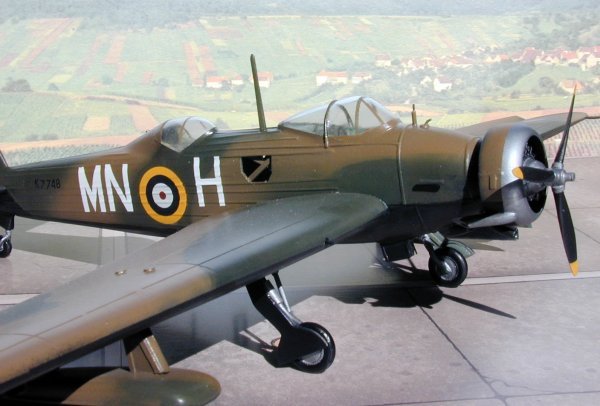
There are two models of the
Wellesley available - a 1:72 kit form Matchbox and a Sanger vacform in 1:48
scale. This model uses the Sanger vacform model as its basis. These
models have a reputation for being difficult. However, spurred on by a previous
vacform kit of the Oxford I had made, I decided to proceed with the Wellesley. A
major advantage of the Sanger series is the choice of subjects available, many
of which feature important, but not well known, British aircraft. They are not,
however, ‘shake and bake’, and to paraphrase an old ad line, one needs to
use ‘…skill, patience and ….a well stocked spares box!’
Construction followed the
traditional manner in that the fuselage and wing shells were cut from the sheet
and sanded down to scale thickness. I always do this step first with vacforms as
it overcomes a psychological barrier. That is, once in this state they tend to
look like a simple injection molded model! The cockpit and machine gunner area
were fully detailed with Plasticard rod and strips, and three bulkheads added to
stiffen the fuselage halves. The use of good references is critical here and
constant checking is the order of the day. In the case of the Wellesley,
interior shots are rare. I was fortunate in having a copy of an old Aeroplane
cutaway in Air International, 1980, kindly provided by Chris Bucholtz.
The wings were joined together
and the control surfaces cut free. The flaps were dropped and the ailerons
separated. These features when added to the model gave it a sense of
superdetailing. Although not easily seen, the wheel wells were detailed using
plastic rod to imitate the geodesic spars in view. Most of the work involved the
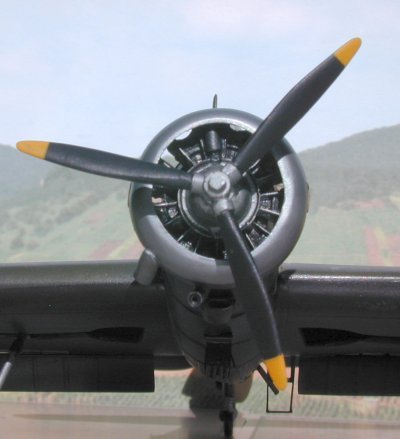
engine and bomb panniers, both of which needed detailing. These were key
features of the original aircraft and I felt they were worth spending time on. A
pannier was opened up and some fictional interior details added, including a
bomb. The engine cowl and engine was scratch built using an old resin engine as
the basis.
Time was
also spent on the transparencies, which were cut from the acrylic backing sheet
and dipped in Future. They were then glued to the aircraft with cyanoacrylate
glue and masked. To ensure that they looked part of the airframe, I filled the
gap between canopy and fuselage with filler, while the mask was in place. This
was then sanded flush and the mask finally removed. A second mask was added when
painting.
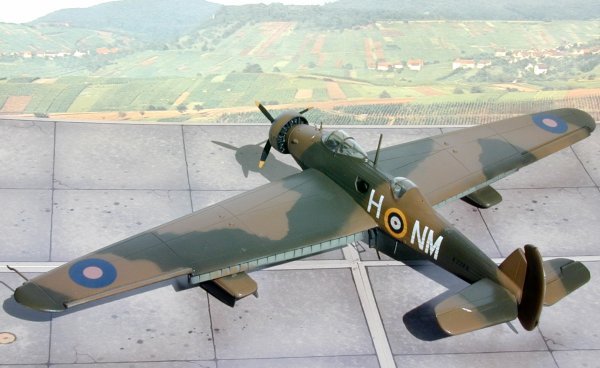
The aircraft was painted
according to the early RAF color scheme in effect at that time, circa 1939,
using Polly S acrylics Decals were from the Carpena range and the model finished
with a coat of Future matted with Tamiya flat. I did no weathering on the model,
as I felt that it would have seen little use when in service in the UK.
I enjoyed making this unique
model – and learning about the aircraft. This summer, I visited the Yorkshire
Air Museum at Elvington, UK, which contains an exhibition about Barnes Wallis.
Here, one can hold an authentic geodesics spar from another Wallis bomber, the
Warwick and feel how light and strong the design was.
Given the size of the wings, a single engine and those under-wing
panniers, it must have looked a remarkable sight when in flight.
Additional details, photos and
model pictures of this and other British aircraft can be found on my website at www.aircraftscalemodeling.com.
Richard
|
|