|
Click on images below to
see larger images |
 |
 |
HISTORY
| Designed
by professor Willy Messershmitt a director of the manufacturer Bayerishe
Flugzeugwerke AG, the prototype Bf-109 first flew in 1935. Progressive
developments quickly led to the Bf-109B and C, which saw active service
with the Condor Legion during the Spanish Civil War. Later model variants
were more powerful and saw action during WW II. The E model was introduced
into the Luftwaffe service in December 1938.
|
| This
model was more powerful, better armed and armored. By the fateful summer
of 1940
over 500 of these were in service for the offensive against England, that
became known as The Battle of Britain.
This
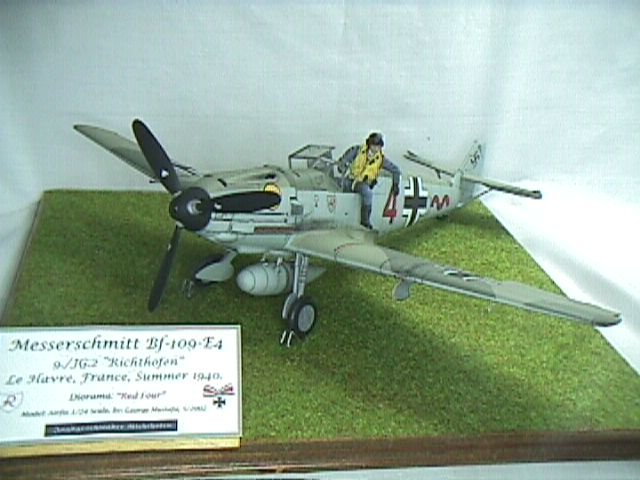
model represents a fighter from 9./JG.2 stationed in Le Havre, France
during the summer of 1940, prior to the Battle of Britain. In my research
I found that this particular aircraft was flown by Haupmann Josef
Wurmheller, which was, at the time depicted in this diorama, not painted
with the yellow nose and rudder typical of the epoch concerning the Battle
of Britain. Hauptmann Wurmheller's Bf-109E-4's nose was later painted
white for recognition purposes. Hauptmann Wurmheller eventually became
Group Commander of 9./JG.2 "Richthofen". In 1941 he was given
command of 6./JG.2 flying Focke-Wulf FW-190's in Norway. He
was killed in an aircraft fire in late 1941. The following is dedicated to
the memory of Hauptmann Wurmheller and this outstanding aircraft.
|
|
THE
KIT
This
Airfix product may be an old mold, but is still a good model. In my research I
found and have just recently read the only article around about this model in
this scale posted in the internet by Mark Mallison, and decided to go ahead and
super detail this model with scratch built items and the available Waldron
instruments, belt buckles and rudder pedals. The model just cried out loudly to
be super detailed!!
It
happens that this model has been sitting in my shelves for 10 years, since I
bought it in a Michigan hobby shop which name I don't remember, back in 1992
when I was stationed at Selfridge AFB. The model was molded in light blue-gray
and was essentially flash free. Ejector marks were minimum and most of the parts
fit pretty well, however, after sitting on the shelf and having endured all the
stress of moving (twice) and the travel to Puerto Rico, some parts were warped
and required some extra work. The plane featured a detailed engine, gun and gun
bays, cockpit and real rubber tires. Perhaps Airfix at one time intended to
motorize these models since there are extra parts to place an electric can type
motor.
This
is my fifth 1/24 scale model from the Airfix collection, and I still have the
Hurricane and the Harrier in the shelves (recently acquired). Deciding what to
do took some research to figure out. The model cries out loud for details, and
in this big scale I decided to go on an all out effort to enhance it. Hence, the
first step was conducting a research. I got information, images and good
reference pictures from books and the Internet. (Sorry I don't mention all the
good web sites I visited, they were too many. But, thanks to all you folks who
have extraordinary sites dedicated to this venerable (and rather infamous)
fighter.
CONSTRUCTION
THE
ENGINE
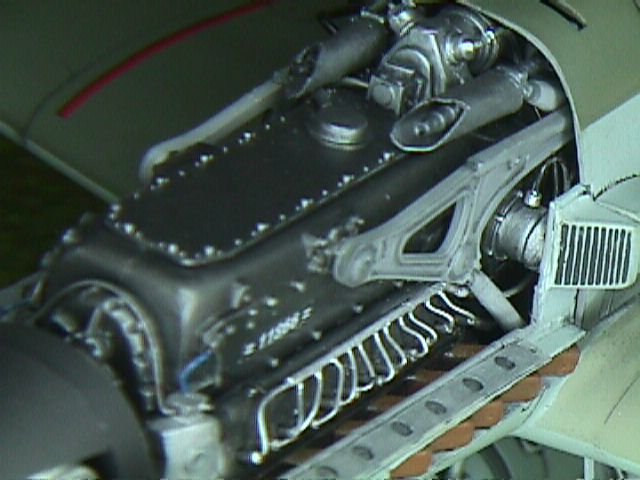
| The
first step was to make a thorough research of the Daimler-Benz DB-601
engine this version of the 109 used. For that matter I surfed the net and
found good reference. Starting from there I proceeded with detailing the
engine. |
|
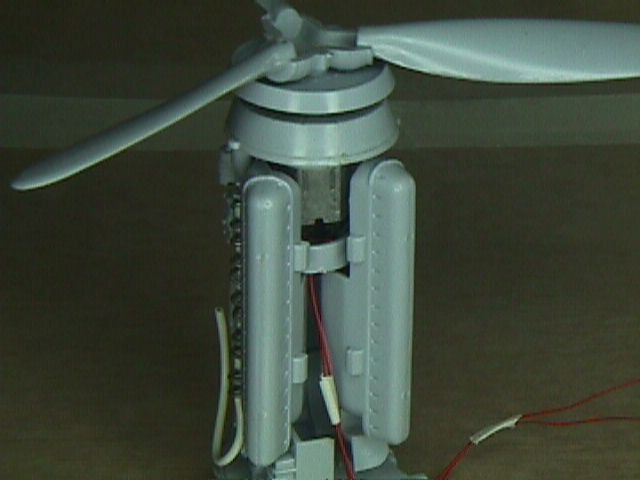
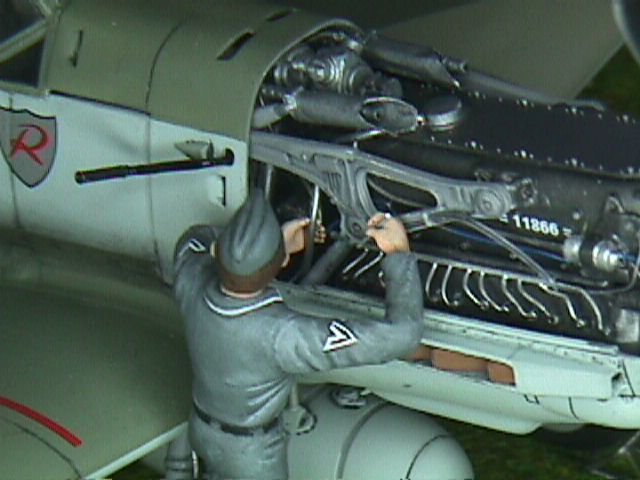
The
model engine, although with some detail, lacked much of the good stuff
that would make it worth the project. Hence I removed all the molded in
detail and added them back from my bag of tricks. In the process I added a
Mabuchi micro motor inside the model's DB-601. I do believe Airfix at one
time intended to have these models motorized since extra parts for the
engine included a motor mount, precisely for a Mabuchi type can electric
motor.
This
model included molded-in exhaust pipes, which of course would have reduced
the overall quality of
the
finished product. I decided to replace them with my scratch built ones.
First, I removed the molded-in pipes with a Dremel Motor-Tool and an X-Acto
blade. Next I placed the engine inside the fuselage halves and took
measurements.
|
|
Click
on image below to see larger image
|
 |
|
My
first attempt was done by cutting, bending and shaping brass stock square
tubing, but I decided they were not what I wanted. Then I decided to use stock
styrene. Using Evergreen rectangular strip styrene .100 x .125, I cut and
heat-bent each exhaust pipe to shape, then super glued them to a sized strip of
Evergreen .15 x .188 styrene. After test fitting them, the new exhaust pipes
were bored out with a Dremel Motor-Tool. The new pipes are a far cry from the
molded-in counterparts. They measure well and were connected to the engine, once
it was installed in the fuselage. Along with the engine, I modified the
propeller to fit the Mabuchi motor. By using stock brass tubing and styrene
tubing I succeeded in reaching the correct size to fit the modified prop shaft.
The
next step was to test fit the engine inside the fuselage halves and run the
electric motor there, (and yes, I did thoroughly checked and ran the motor prior
to closing the kit's model engine!!).
| The
motor runs on a three volt battery located inside the external fuel
tank, on a scratch built mount with styrene base and brass contacts. (I
borrowed the fuel tank from the Airfix 1/24 scale Fw-190 in my
collection and in its place installed the FW-190 kit bomb). The
under-fuselage hard point was carved to scale specs from balsa wood and
later covered with Tamiya epoxy putty. |
| Part
of the engine modification included the cowling. I added internal
structures as per my references. The 109E featured a one piece upper
cowling that was removed by loosening four latches at the igniter or
spark-plug access cover, and four latches at each corner of the cowling.
I made four working latches at the corners and cut out the molded plug
access covers and made them new from stock styrene with working hinges
and pin latches. |
| Click
on images below to see larger images |
 |
 |
|
THE
COCKPIT
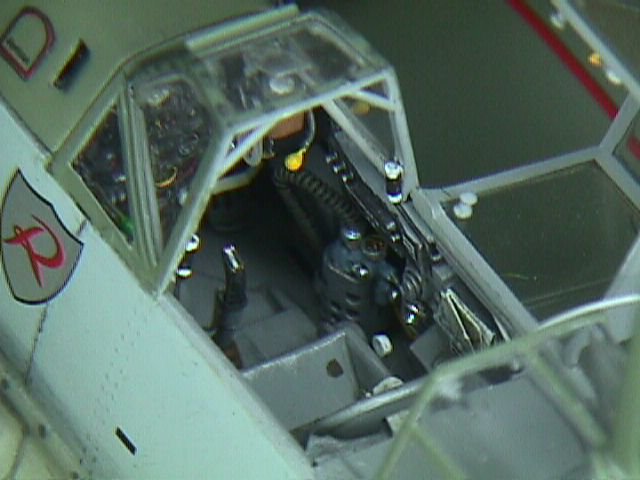
| The
Airfix model comes with a decently detailed cockpit, however, it cried out
forsuper
detailing. Adding the Waldron German instruments, seat belt buckles and
rudder pedals was for me not enough. For that matter I decided to further
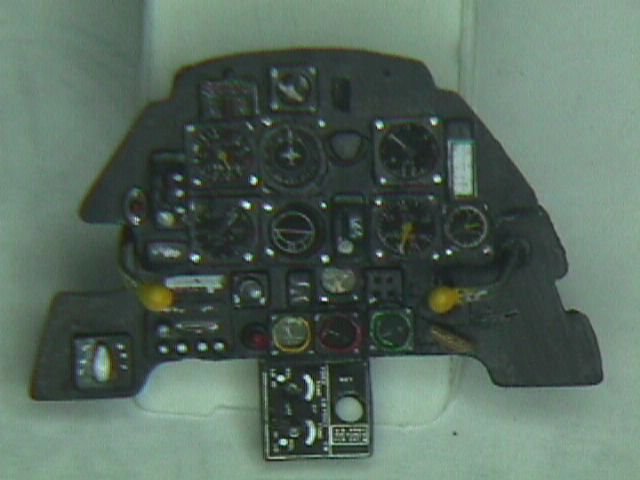
detail the cockpit a bit more. I started out with the instrument panel.
Using the kit's instrument panel, I modified it to accept the Waldron
instruments, and added levers, switches and placards according to my
references. Later E models incorporated the under fuselage hard point and
a center or pedestal panel in the cockpit. I made the placards in my
computer, printed to scale, cut and pasted in place.
|
| Click
on image below to see larger image |
 |
|
Next,
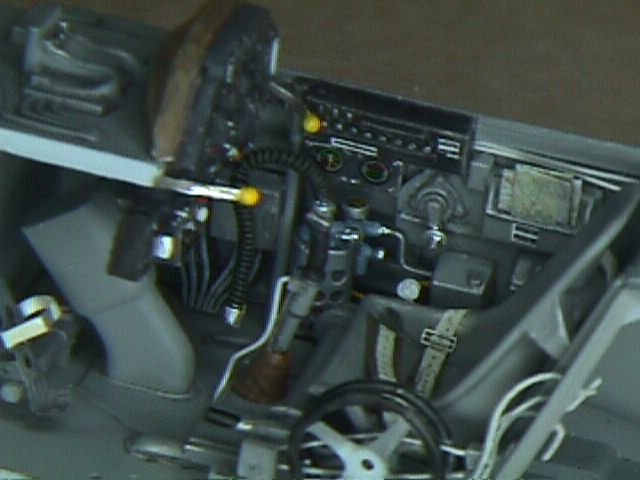
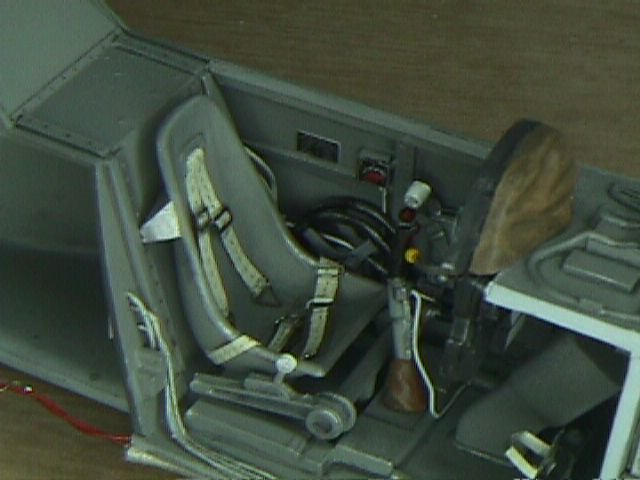
I reconstructed the cockpit walls. The throttle and mixture levers were scratch
built using flat brass and the kit's handles and throttle quadrant base.
Interior structural details were added with stock styrene. The elevator trim and
horizontal angle of attack trim wheels operated with a sprocket and chain
system. I reproduced such with styrene blocks shaped to size and round styrene
stock. The same with the right side wall. I removed some of the built in details
and replaced them with scratch built items.
|
Click on images below to
see larger images |
 |
 |
The
oxygen hose was replaced with a new one made out of wire-wound-around-a-solder
core, painted and weathered. Other goodies included, hollowing out the map case
(at the rear of the right wall) and adding cut out small picture of a real
aeronautical VFR terminal chart photo from a general aviation pilot
paraphernalia catalog, folded and cemented in place with white glue. The canopy
crank handle was made from solder. I added small gauge wires to simulate the
109's internal wiring, including the stick wiring, as per reference photos. Note
info placards in the radio/circuit breaker panel and other places. I also added
a small two gauge panel under the radio/circuit breaker panel in the right
cockpit wall, and a gauge atop the oxygen cylinder regulator from the Waldron
instrument plate. This panel housed the oxygen gauges in later E models. The
seat belts were fashioned from white gift-wrapping nylon band (the kind used to
fashion those adornments in Christmas), and used the Waldron buckle set. I added
the Waldron German rudder pedals and the securing strap, later E models used
this kind of pedals. After getting the cockpit components together, the results
were very pleasing.
THE WINGS
It is a shame that a model of this size and detail was
developed not taking into consideration such details as the landing gear wheel
wells. Following Mark Mallinson's article and recommendations, I scratch built
the wells as per my references. I added wheel well details with stock styrene,
and developed a hinge for the under wing armament access covers.
|
Click on images below to
see larger images |
 |
 |
I
cut out the flaps and reworked the trailing edge of the wings and the leading
edge of the flaps ( a real treat!). They were positioned down as per references.
(109's were usually parked with the flaps down). The kit's undercarriage was
slightly modified and used for this project. Since the same is very close to
specs, I didn't want to go into constructing aluminum/brass replacements. Since
the E models incorporated the leading edge wing slats, and the Airfix model had
the molded-in, I decided to leave them as they were, and not mess with them.
Perhaps it might detract from the authenticity of the model, but I find it
irrelevant and can live with it.
OTHER
INTERNAL AND EXTERNAL DETAILING
Canopy
and windshield modifications were done by adding the internal struts in the
windshield, the top hand holds, and the mechanism to open the left vent
Plexiglas. The rest was done by masking and painting the internal frames
interior colors, and the external frames the camouflage color. The canopy opens
and closes, and has the safety strap to prevent damage if it traveled further
than the normal travel when open. Also, the cockpit night lamps and the locking
mechanism were added to both sides of the windshield frame and the left side of
the canopy frame.
MODEL
ASSEMBLY, PAINTING AND WEATHERING
Assembly
went on pretty much straight forward. However, the model was slightly warped (as
can be expected of an old model). The fuselage and the wings had to be worked
out of the unwanted warping that prevented a clean assembly. Some filling was
needed in the fuselage and the wings, but after that the model was pretty much
assembled and ready for paint.
| I
primed the whole model with the Tamiya Primer to create a smooth, uniform
surface and
check for unwanted scratches, unfilled seams, etc. In fact, I found few
areas that required a bit more work. After that, I used Model Master RLM
colors as recommended in the Eagle Strike decal instruction. After
confirming the color scheme in the Web, I proceeded to paint the model
according to the standard Luftwaffe patterns of the time, RLM 02, RLM71 on
top, and RLM 76 underneath. In fact, I wanted to stay away from the
"Mottling" scheme that most 109's portrayed and decided to stick
to the original three color scheme, to preserve the beauty of the lines of
this aircraft. |
| Click
on image below to see larger image |
 |
|
DECALS
Since
this particular model had been sitting in my shop shelves for ten years, and
providing that here in the tropics, humidity and the heat is so high, the decals
that came with the model were ruined. In its place I obtained Eagle Strike's
excellent 1/24 scale decals for this model. These were applied over the gloss
finish of the model, and went on smoothly and conformed to the surface easily. I
must commend the fine job Eagle Strike's people did with these decals. After
applying them, and weathering the model, I over coated the plane with Model
Masters Flat clear coat obtaining an excellent flat appearance and sealing the
decals over the model.
Weathering
was done pretty much using the standard methods. First an overcoat of Model
Master's gloss clear, and a wash of thinned water color (Kid's finger paint type
worked fine) with few drops of dish washing liquid. This technique helped
achieve the effect on panel lines, crevices, etc. I decided to keep the paint
pretty much intact, since this particular aircraft was, at the time of this
scene, fairly new, just few months since its delivery from the factory. The
trailing exhaust marks in the fuselage sides were achieved using ground
down pastels. Finally, the underside of the plane was then dirtied a bit to show
some use, leaking oil, etc.
PILOT
AND GROUND
CREW FIGURES
Models
of this size demand attention to detail, which includes figures. It is a shame
that manufactures have stayed away from creating figures in 1/24 scale. The only
available figures are the auto mechanic set from Fujimi. I reworked these
figures, repositioning them to suit the need. Using the excellent Tamiya epoxy
putty, I filled gaps, and added the flight caps to these two figures. Paint and
patience converted them into Luftwaffe mechanics. (Ironically, they became from
modern auto mechanics, to Luftwaffe mechanics, they remained anyway,
mechanics...)
|
Click on images below to
see larger images |
 |
 |
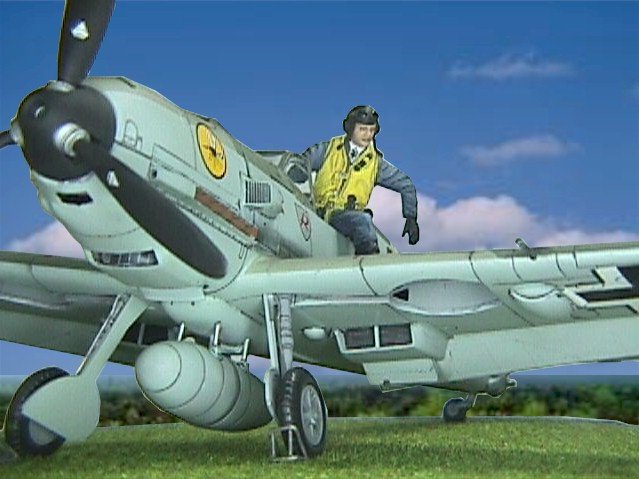
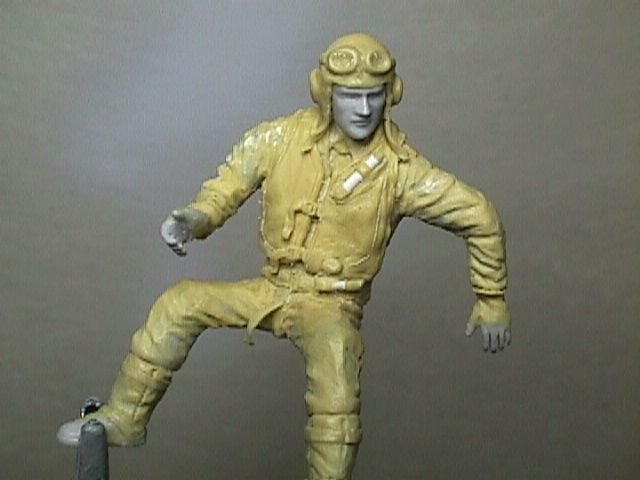
Since
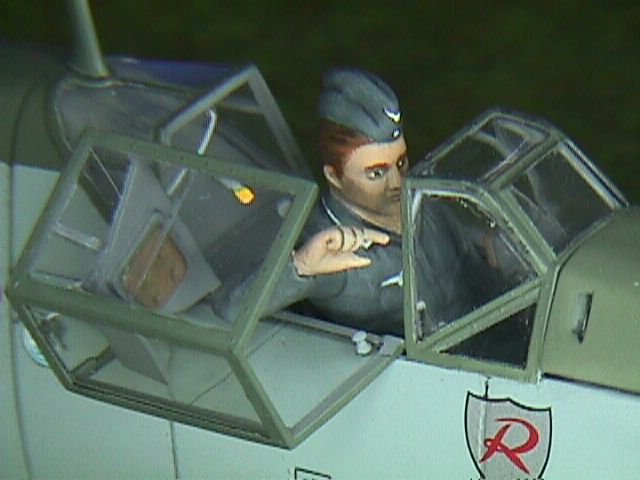
I decided to make this a "posable" diorama, I also reworked another
Fujimi figure and posed him as a pilot climbing out of the cockpit after a
mission. For this I cut out the figure in all its joints, drilled small holes
and affixed the parts back with wire pins. This technique gave me the
opportunity to pose the figure, as I wanted. After that, I filled the gaps of
every joint and made the flight jacket (Luftwaffe standard of the day), the
trouser, the boots, gloves, life jacket and flight helmet with the Tamiya putty.
Painting was accomplished with artists oil's (such as the other two figures).
THE
FINISHED MODEL
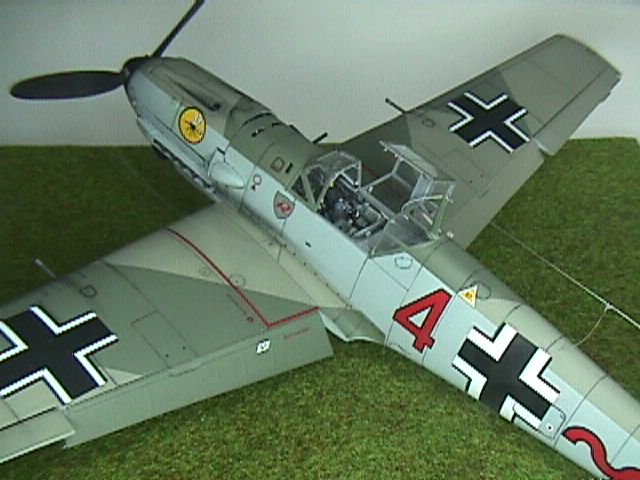
All
the effort, the countless hours of work, the four months of building time, hopes
and dreams do pay off when you get the final product. The following pictures
depict the finished model. Note that this model has an electric motor inside the
Daimler-Benz D601 to spin the propeller.
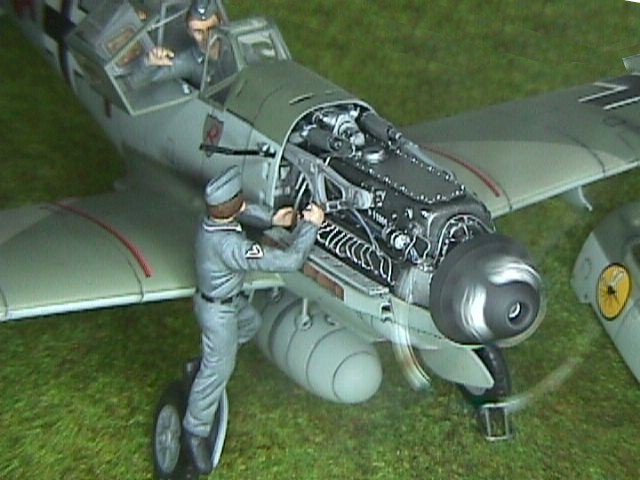
Furthermore,
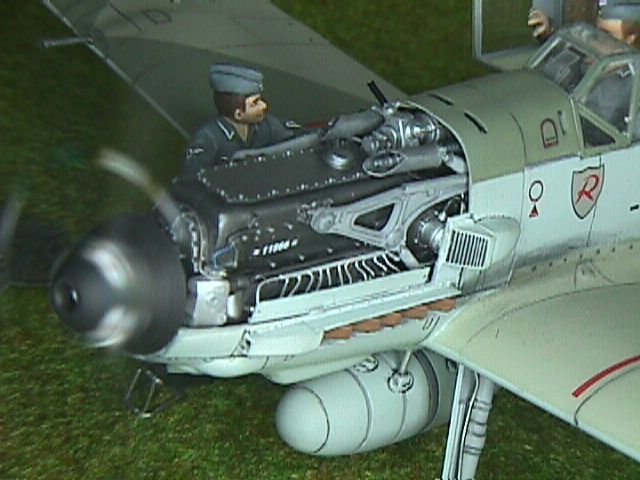
I made this aircraft and the diorama "posable". One scene depicts the
pilot, Hauptmann Josef Wurmheller climbing out of the cockpit after arriving
from a mission. The other scene depicts the engine cowling removed, and a
mechanic working with the engine (perhaps fine tuning it) with another mechanic
in the cockpit and the engine running.
CONCLUSION
Making
this model to the level of complexity and detail I decided to add was a very
rewarding experience. I'm very pleased with the end result, and it makes a fine
addition to my collection. The only drawback of this large scale is the lack of
space to display it. For the better part of the project I estimate over 150
hours of work in the course of four months.
As
for the model itself, Airfix 1/24 scale models were the pioneers in the scale,
and allowed modelers to experience the thrill of building large and super
detailing big time, however, it is a shame that with all those excellent
aftermarket products, no one has thought of making some for the 1/24 scale
series, other than the most recent set in the market for the FW-190. I'm looking
forward to seeing what Trumpeter will bring us in their upcoming 1/24 scale
series. If they apply the same level of detail as they did with their 1/32 scale
A-10, I'm in for more 1/24 aircraft and less space to display them.
My
next large project will be the Airfix 1/24 scale Harrier. For this one I have
already ordered the Flight Path's excellent detail kit and accessories. I plan
to do a "possable" diorama portraying the Harrier in maintenance and
ready for flight, (I guess I like tough projects).
Until
the next one…
George
|
|