|
The Boeing AH-64 Apache has become the attack helicopter of choice in the West.
Westland in Great Britain is producing the Longbow Apache (under license from
Boeing) for the British Army, and the Dutch Army has procured the Apache for use
as well. The Apache is also used by
the Israeli Defence Force and is closing in on 15 years of service with the
United States Army. The U.S. Army
upgraded to the AH-64D Longbow Apache, with its distinct rotor mounted fire
control radar, improved avionics, and assymetrical enlarged sponsons in 1998,
extending the Apache’s service life well into the 21st century.
On
the heels of the recently released Longbow Apache, Hasegawa has issued the
AH-64A Apache in 1/48 scale. The
kit contains 278(!) parts, a lot for a helicopter, and is molded in medium gray
styrene. The fuselage is well
molded, has recessed panel lines and raised pop rivets.
One feature unique to both kits is they contain vinyl grommets that you
insert into the main rotor mount, tail rotor, chain gun mount and the TADS
Targeting assembly. This allows the
rotors and chain gun to be mounted after painting, and removal for transport to
shows and contests. The clear parts
for the canopy are packaged separately and are distortion free.
Also included on the clear sprue are the lenses for the navigation
lights, the ALQ-144 IR Jammer, and seeker heads for the Hellfire missiles.
Assembly
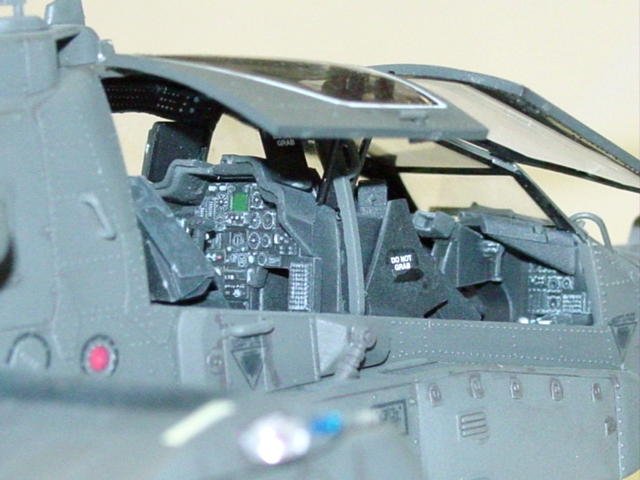
starts with the cockpit and main rotor mount. The
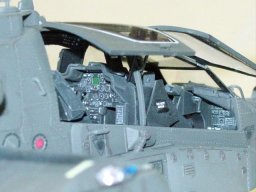
cockpit is well molded and features four separate side consoles, each containing
raised knobs, switches, and buttons. The
instrument panels have raised details as well, which make painting and detailing
a breeze. Prior to painting, the
main cockpit assembly and other interior tidbits were mounted on toothpicks
using good ole’ blue fun tack to hold them in place.
All interior parts were painted Model Master interior black with 20%
white added for scale effect. I
also painted the Hellfire missiles and the rotor blades as these are also black.
While the interior parts were drying, the main rotor mount was assembled
and painted Model Master FS 34031 Army Helo Drab.
The instrument panels and side consoles were detail painted with medium
gray for the knobs, silver for the switches,
and light gray for the buttons. The
instrument panels were drybrushed with white, then future floor wax was added to
simulate glass over the gauges. I
took the black and again, added white to lighten it, then drybrushed over the
entire cockpit to add some depth. With
the detail painting complete, the rudder pedals were installed and painted, the
collective and cyclic controls added, and the instrument panels glued in place.
The seats were painted and added to the cockpit as well. One
crictism I have is the seats are devoid of texture and are missing the lap
belts. After the instrument shrouds
were installed, it was time to glue the main rotor mount and cockpit into the
right fuselage half. Make sure the
rotor mount is level and the vinyl grommet for the tail rotor is in place before
joining the fuselage halves.
|
Click on images below to
see larger images |
 |
 |
The
fuselage was assembled and the seam sanded out then polished with a 3-way nail
buffer. Take care when sanding the
seam on the bottom so you don’t lose a lot of
the raised rivets. It’s
imperative the landing gear are attached prior to installing the sponsons and
bottom fuselage plate, as this allows you make sure the struts are level and the
model sits right. The wings were
added next, followed by the sponsons, and the bottom fuselage plate.
As is the case with the tail rotor, a vinyl grommet was installed for the
chain gun mount prior to gluing the bottom plate to the fuselage.
The engines were put together, then glued to the fuselage.
The stabilator, tail wheel, and TADS system were assembled and installed.
Speaking of the TADS, I tinted the targeting lenses with pearl powders to
simulate the violet refective coating found on most modern optics.
With the fuselage complete, I turned my attention to the canopy.
The canopy was masked off with bare metal foil, painted black first
(interior color), then Army Helo Drab. I
added as many of the exterior parts that were possible (grab handles, various
bumps and lumps, etc.) then it was time to hit the paint booth.
|
Click on images below to
see larger images |
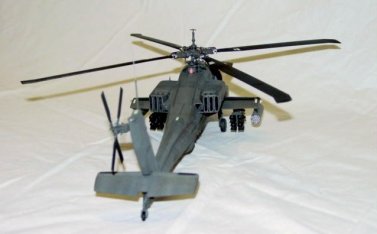 |
 |
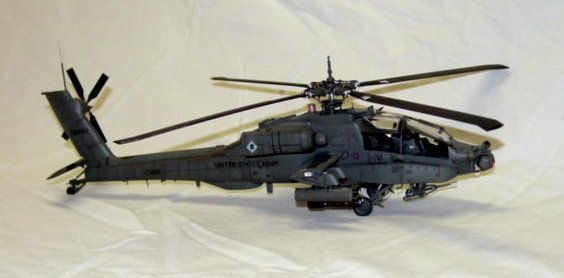
Painting the Apache is pretty simple, if it’s not black, then it’s FS
34031 Army Helo Drab.
The trick is trying to vary the finish to give some depth and break the
monochromatic look.
This was achieved by first spraying flat black around the panel lines,
access doors and the rows of rivets.
At this time I took the opportunity to check for surface flaws and make
corrections. Army
Helo Drab was applied straight from the jar in thin, light coats so the black
would not be obscured and buried.
After a day of drying, I applied more Army Helo Drab, but with white
added for highlight.
I sprayed the leading edges of the wings and forward facing surfaces, as
well as the top of the helicopter and in between the rows of rivets.
The result was a worn, faded, but not abused finish.
After the paint dried, it was time to prepare the model for decal
application. Two
to three coats of Future floor wax were sprayed on the model, then allowed to
dry. While
the gloss coat was drying, I detail painted the rotors and 30mm chain gun.
The decals are well printed, and respond to setting solutions. I
like using the Micro-Scale system as these setting solutions aren’t as harsh
as other solvents, but are still effective. I
used black decal film to simulate the non-skid material on the walk ways as this
was easier than trying to paint them on.
The decals were also applied to the missles and FFAR pods.
I used a thinner wash of burnt sienna to accentuate the panel lines and
various vents.
After going over the decals to make sure they had conformed to the model,
I sprayed several thin coats of Testors Acryl Dull coat to produce a
smooth, flat finish.
The blast shield, canopy, and navigation lights were added with Micro
Krystal Kleer thinned with a little water.
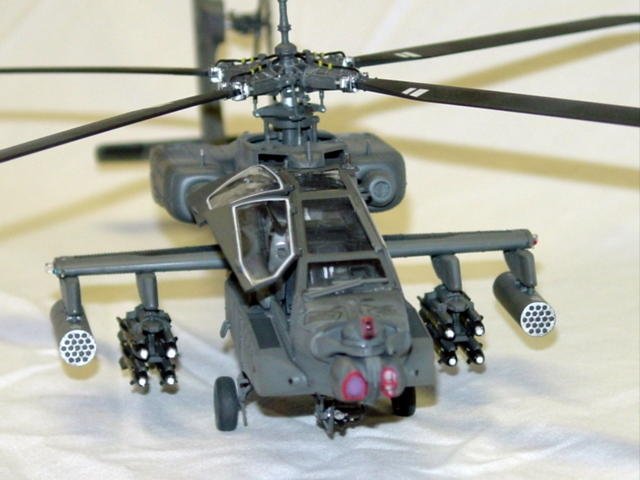
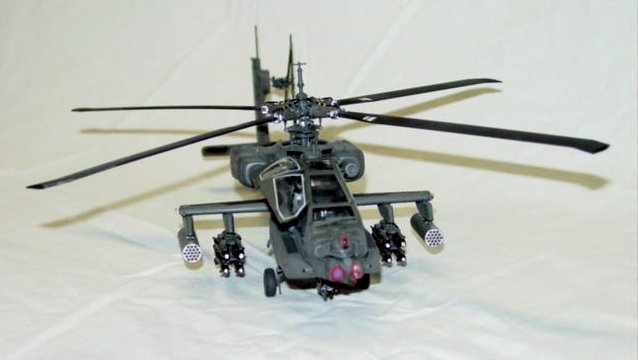
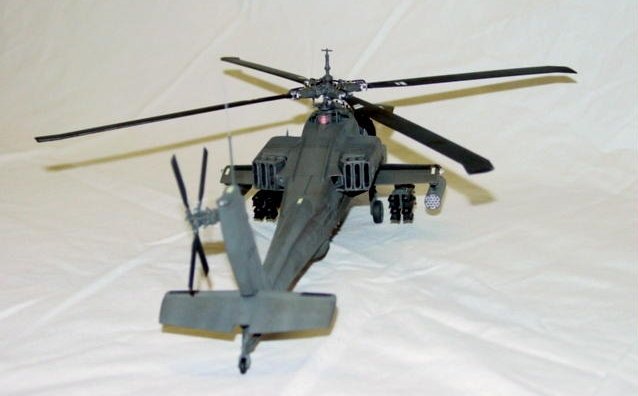
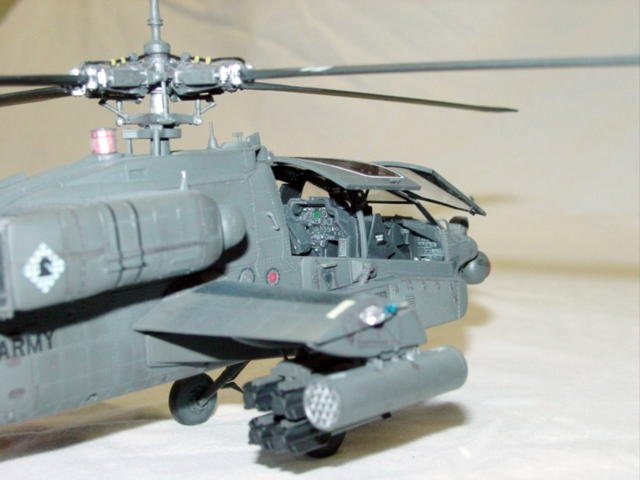
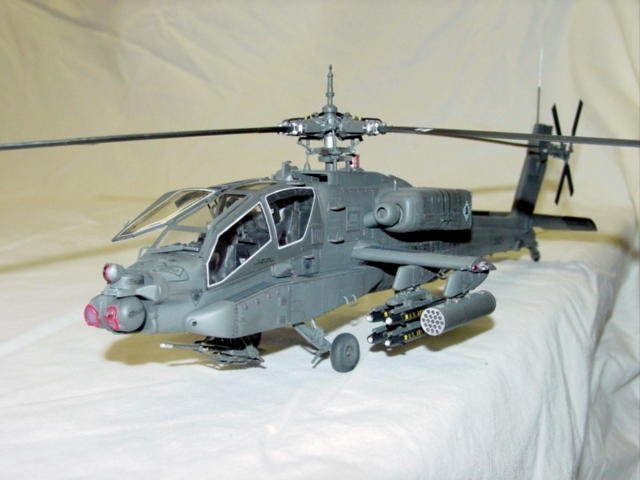
The rotors were installed, the FFAR pods and missile racks were hung on
the stub wings and with that, the model was completed.
The Apache is a machine only its mother could love and Hasegawa has done
an outstanding job capturing its ungainly lines.
This kit is hands down the best 1/48 scale Apache on the market, though
the MSRP of $38.00 dollars may shy some modelers away.
The price is justified though as this kit is well engineered, has
excellent detail, and builds into a fine replica. The
parts count and small pieces may give beginners some trouble, but experienced
builders will have no problems adding the premiere attack helicopter of the free
world to their modern aviation collection.
Highly recommended and then some.
Albert
|
|