|
Since its combat debut in 1944, in the jungles of Burma, the helicopter
provided capabilities military aviators never thought possible. Fielded too late
to be used to its full potential in the Second World War, the helicopter matured
as a combat aircraft during the Korean conflict. Then later, as the United
States Army began massing troops in Vietnam, combat planners, with a good bit of
rotary wing employment experience, wrote the venerable helicopter heavily into
the script.
To capitalize on the helicopter's combat capability, the Army adopted a new
doctrine known as Air Mobile Operations. The concept was ideally suited to
combat in Vietnam. It dictated the rapid movement of men and equipment, over
large distances, using cargo and troop transport helicopters. The Army had
sufficient numbers of cargo and troop lift helicopters; however, if the Air
Mobile concept was to be a success, a dedicated attack helicopter would be
needed to protect the troop carriers and transports.
The Army turned to Bell Helicopter and asked the company to design and build
the attack helicopter so badly needed to round out the Air Mobile concept.
Although the Army's need was urgent, it would take Bell some time to produce and
test a design. As a stop gap measure, the Army pressed the venerable Huey into
attack helicopter service. Although the Huey was an excellent troop carrier, its
inherent instability and its low speed limited its potential as a gunship. In
spite of its limitations, the Huey gunships provided an effective interim
aircraft until the Cobra arrived in Southeast Asia. Even after the Cobra
arrived, Huey gunships continued to augment the fight.
Bell Helicopter answered the Army request by designing and building the
world's first true attack helicopter, the AH-1 Cobra. Its civilian designation,
the Bell 209, the Cobra was derived from the twin beam construction and basic
drive train of the UH-1 Huey. Instead of the Huey's wide body construction;
however, the Cobra used a two-place tandem seating arrangement, and stubby wings
on which to hang weapons. Not including the wings, the AH-1 was a mere 36 inches
wide. The pilot sat in the rear seat while the co-pilot gunner occupied the
front seat.
(Click on the photos and diagrams to see the
full size images)
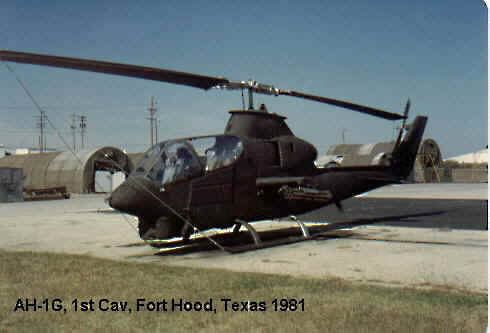
AH-1G
From the outset, the Army wanted high speed and stability for its new weapons
platform. Each of these requirements taxed the technological capabilities of
helicopter designers, and Bell deserved a lot of praise for meeting the Army's
demand in such a short time. To provide the necessary speed requirements, Bell
exerted a great deal of effort in the reduction of parasite drag. To achieve
this, the aircraft was designed with as little frontal area as possible, and it
sported a fighter like canopy. Additionally, the fuselage and tailboom used
flush rivet construction. The stub wings were aerodynamic, aiding the rotor
system in overall lift generation. To reduce drag further, Bell designed the
Cobra prototype with retractable skids. Because of this system's complexity and
because of its excessive weight penalty Bell chose not to employ the retractable
skid system on production aircraft. Since landing skids were a requirement,
engineers fitted the cross tube assemblies with aerodynamic fairings. These
fairings, while a simple addition, reduced drag appreciably (the cross tube
fairings were discarded after the introduction of the TOW Cobra models).
The Cobra utilized the same drive train as the Huey, however, the rotor
system was re-designed. Although still semi-rigid in design, the Cobra rotor
system sported wider more efficient rotor blades. This combination of low drag
and efficient rotors, resulted in an aircraft capable of diving speeds in excess
of 190 knots. Bell had achieved the Army's speed requirements, now all that
remained was to make the new aircraft stable.
Stability and helicopters, especially in the 1960's, were terms that tended
to be mutually exclusive. Helicopters by their nature were not very stable. To
produce a measure of stability in their trademark two bladed rotor systems, Bell
used a rather simple stabilizer bar system. This design; however, proved
inadequate for use on the Cobra, primarily because the stability offered by the
stabilizer bar was inadequate and it posed a rather large drag penalty.
Additionally, the mechanical stabilizer bar assembly inhibited maneuverability.
Instead of a mechanical stabilizer system, Bell engineers fitted the Cobra
with an electronic system. Stability Control Augmentation System or SCAS as it
would come to known, utilized a series of rate gyros (one gyro coupled to each
aerodynamic axis) and hydraulic actuators that, without any pilot input,
dampened undesirable flight related forces. The result was an extremely stable
weapons platform with a high measure of maneuverability.
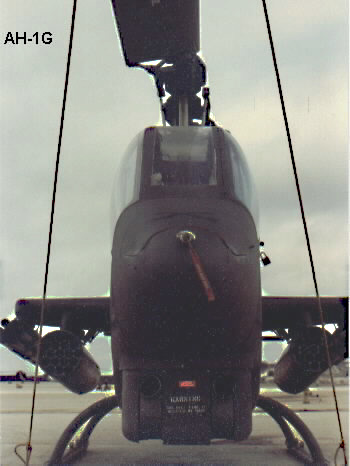
The AH-1G (the G model being the initial production model) Cobra reached
Vietnam in 1967 and quickly proved its worth in combat. Equipped with a chin
mounted turret and wing mounted rocket pods, the helicopter possessed tremendous
firepower. Early versions carried only a 7.62mm mini-gun in the turret and bomb
racks on the wings for up to four rocket pods. Rocket pods came in either 7 shot
or 19 shot varieties. Later versions of the "G" model saw the
inclusion of a 40mm grenade launcher in the turret and some specially modified
aircraft mounted a six barreled 20mm Gatling gun on the left wing. The 20mm
gunship was a cumbersome affair with the ammo storage boxes and feed chutes
mounted externally along either side of the fuselage. This arrangement was
extremely complex and resulted in frequent jams.
(Click on the photos and diagrams to see the
full size images)
Early "G" models employed a conventional tail rotor located on the
left side of the vertical fin. After operation in the field; however, this
configuration proved inadequate. To improve directional control, Bell
re-configured subsequent production aircraft with the tail rotor system mounted
on the opposite side of the vertical fin. This new tail rotor was known as a
"Tractor" tail rotor because it pulled instead of pushed the tail boom
like the earlier design. (Revell's 1/32 scale AH-1G employs the earlier
type, conventional tail rotor).
All Cobra variants employ a distinctive cambered vertical fin. In a
helicopter, as power is increased (as airspeed increases, power must be
increased to maintain altitude), left pedal input must be increased
correspondingly to maintain directional control. In the Cobra, the cambered fin
actually reduces the amount of left pedal input required when airspeed
increases. Without this design, at high airspeeds, Cobra pilots could run out of
available left pedal and a loss of directional control.
In only a short period, Bell's Cobra proved its worth as an attack
helicopter. With its high speed, tremendous maneuverability, and its awesome
firepower, the Cobra changed helicopter combat forever. While operations in
Vietnam, proved the type's worth, the Cobra's true capabilities would not be
realized for years to come.
After Vietnam, the Army's attack helicopter mission changed significantly.
Previously, the Cobra's main mission had been close air support, a mission that
specifically suited its design. The onset of the Cold War; however, resulted in
a new threat, a threat that would mandate an entirely different method of
employment for the venerable AH-1.
The new threat came in the form of massive numbers of Soviet tanks, and Army
planners were wrestling with a way to counter the enemy armor force should a
conflict arise. Building an allied armor force capable of countering the Soviet
force, would be extremely expensive so military tacticians looked elsewhere for
an answer. The ultimate decision, a decision that initially, was not very
obvious, was to employ the existing attack helicopter force against the superior
numbers of Soviet tanks. Army brass believed that with the helicopter's agility,
and new helicopter launched, anti-tank missile technology, parity on the modern
battlefield, was achievable.
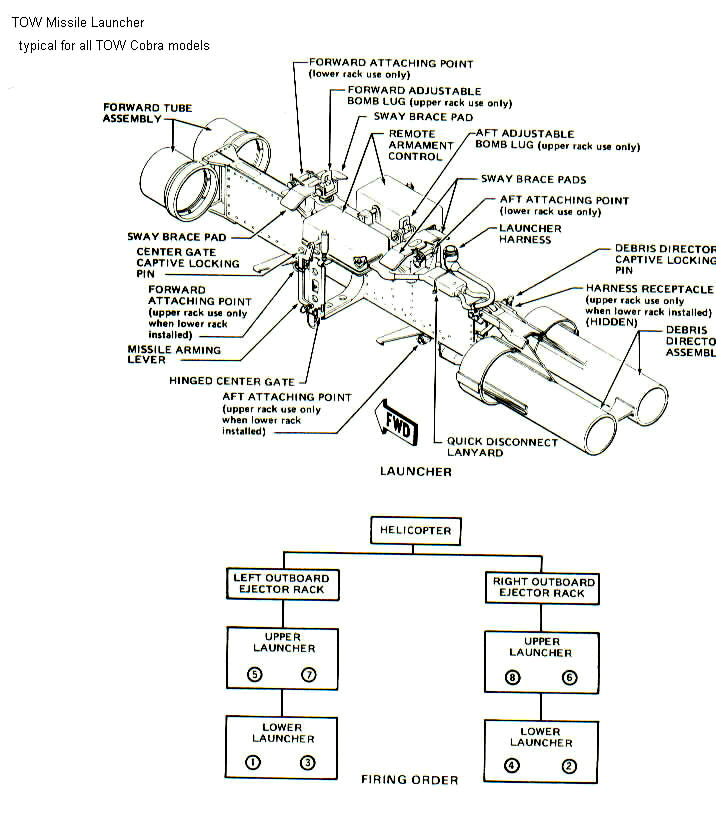
In the latter days of the Vietnam conflict, the Army experimented with wire
guided anti-armor missiles. Results proved promising and the Army decided to
mate the TOW (Tube launched, Optically tracked, Wire guided) missile to the AH-1
helicopter. This conjunction resulted in the "S" model Cobra or AH-1S.
Actually, the first TOW equipped Cobra was the prototype designated AH-1Q. The
"Q" was simply a "G" model (which retained the 1300 Shaft
Horsepower engine of the "G") with the TOW system, optics, and
launchers installed.
(Click on the photos and diagrams to see the
full size images)
TOW Missile Launcher
The first operational "S" models were "G" models modified
by Bell to full S standards. The new Cobra included an upgraded drivetrain (an
1800 shaft horsepower engine), a Telescopic Sight Unit (TSU), a helmet sight
system, and articulated bomb racks to support the TOW missile launchers. These
aircraft, known as the "MOD S" Cobras retained the original smooth
canopy of the "G" model. As the result of a more powerful engine and
transmission, and a strengthened airframe, Bell increased gross weight from
9,500 pounds to 10,000 pounds.
(Click on the photos and diagrams to see the
full size images)
After introduction of the "MOD S" Army AH-1 lineage tends to become
confusing. Contributing to this confusion was the Army's way of identifying
subsequent Cobra models. After the "MOD S", three other TOW variants
were produced. These three later variants as well as the original "MOD
S" were all "S" models. The Army delineated variants by
succeeding the "S" in AH-1S with a descriptive acronym surrounded by
parenthesis. As an example, the "MOD S" was the AH-1S (MOD).
The AH-1S (MOD) was followed by the AH-1S (PROD). The "PROD S"
consisted of airframes built from inception as "S" models, or
"MOD S" Cobras that were rebuilt from the box beams up. The "PROD
S" was the first "S" model to employ the new flat plate canopy
and the integral night vision compatible, cockpit instruments. The "PROD
S" retained the original hydraulic chin turret.
After the "PROD S" came the AH-1S (ECAS). ECAS stands for Enhanced
Cobra Armament System, and the ECAS Cobra was an attempt to improve defensive
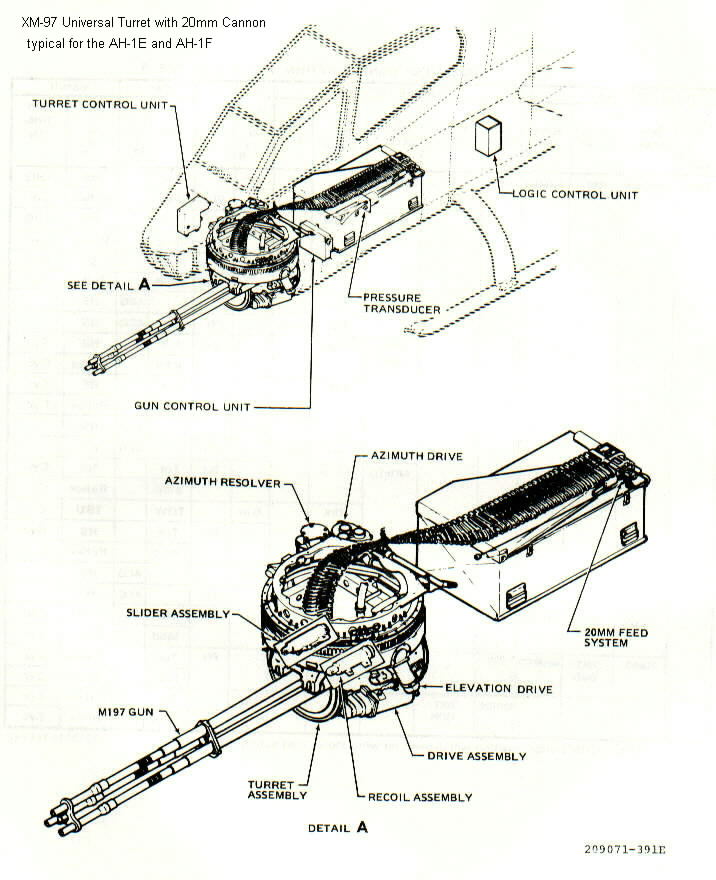
armament. To do this, Bell removed the old hydraulically powered chin turret and
replaced it with the electrically powered XM-97 Universal Turret. To handle the
additional AC electrical load, Bell installed a 10KVA alternator, mounted on the
left side of the aircraft transmission. The alternator installation necessitated
modification of the left transmission cowling resulting in a teardrop shaped
bulge. This bulge is a common characteristic of both the ECAS and Modernized
Cobra variants. The ECAS Cobra retained the flat plate canopy introduced on the
PROD.
(Click on the photos and diagrams to see the
full size images)
AH-1E (ECAS)
The Universal Turret was designed to mount either a mini-gun, a grenade
launcher, or the XM-197, 20MM cannon. In the field, the aircraft only carried
the 20MM cannon, and operational units never stocked other weapon systems for
the turret. The XM-197 differed from the original 20MM gattling gun in that it
consisted of three barrels instead of six, and had a reduced rate of fire. The
ammunition box for the 20MM cannon was a single rectangular box, constructed of
fiberglass, and sporting a self contained feed motor. Earlier variants equipped
with the faired hydraulic turret, employed twin ammunition containers that were
cylindrical in shape. One container stored 40MM grenades and the other stored
mini-gun ammunition.
(Click on the photos and diagrams to see the
full size images)
The final Army variant was the AH-1S (FM). FM stands for Fully Modernized,
and this variant included a host of upgrades designed to improve weapons
delivery and battlefield survivability. The modernized Cobra included a Heads Up
Display which replaced the aging XM-73 reflex sight found on all previous Cobra
variants. Additionally, the Modernized Cobra employed a solid state fire control
computer and an updated Rocket Management System. One of the Modernized Cobras'
more distinctive features is the air data sensor mounted externally on a boom,
and fixed to the right side of the canopy frame. The Modernized Cobra also
featured state of the art battlefield countermeasures in the form of a radar
jammer, an IR jammer, and a laser range finder. The radar jammer, when
installed, was housed in a clear blister on the upper transmission cowling. The
IR jammer or disco light as it is usually called, mounted on the top of the
engine cowling. The laser range finder was mounted inside the Telescopic Sight
Unit (TSU) (left of the telescope if you are looking aft).
(Click on the photos and diagrams to see the
full size images)
AH-1F Gunner's Station
AH-1F Pilot's Cockpit
To improve the Cobra's night fighting capability, the Army experimented with
an Infra-red TSU. In the late 1980's, several aircraft from 268th
Attack Helicopter Battalion at Fort Lewis, Washington, took part in the test.
The Army never adopted the system for fleet wide use however, and the Army Cobra
fleet's night capabilities remained limited throughout its operational career.
Although the "FM" was the premier Army Cobra, the additional
systems added weight to an aircraft that was already too heavy. With full fuel
and all systems installed, the modernized Cobra weighed in at nearly 9,700
pounds. With a max gross weight of only 10,000 pounds, the flight crew had to
limit the fuel load, or severely restrict the amount of ordnance carried.
In the mid 1980's, the Army thankfully re-designated the Cobra fleet. The
"MOD S" was re-designated, AH-1M. The "PROD S" was
re-designated, AH-1P. The "ECAS S" was re-designated, AH-1E, and
finally, the fully modernized Cobra was re-designated, AH-1F. Although these
designations do not help to determine the lineage's order, they go along way in
reducing variant confusion, and help delineate one Cobra model from the other.
(Click on the photos and diagrams to see the
full size images)
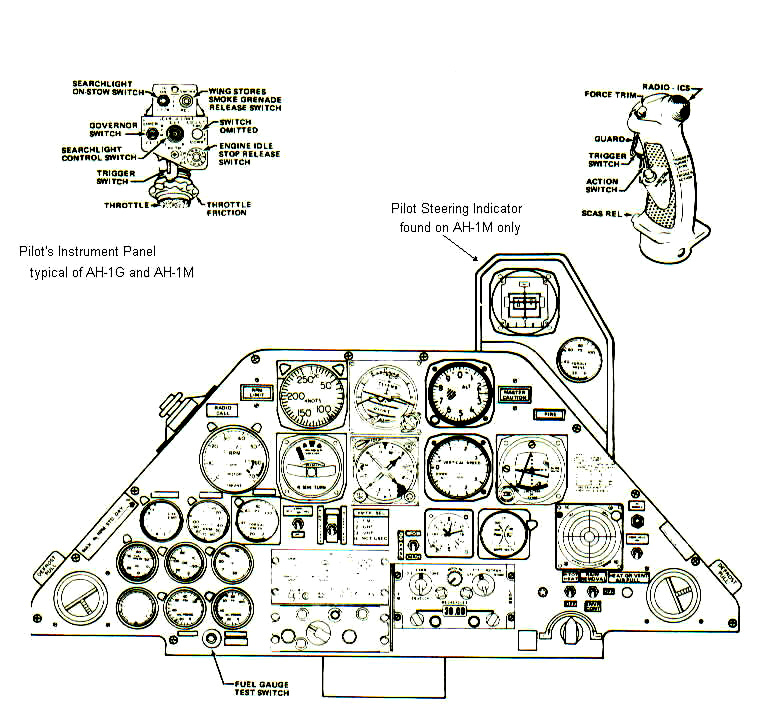
AH-1M Pilot's Instrument Panel and Gunner's
Station
The AH-1 Cobra holds the distinction of being the world's first true attack
helicopter. Throughout its service life, the aircraft has served admirably in
numerous conflicts and it played a major role in deterring Soviet Aggression
during the Cold War. Like combat tactics, the AH-1 has adapted to new methods of
employment, and today, more than thirty years after it first flew, the Army
Cobra fleet continues to soldier on with the Army National Guard. The only model
currently in operation is the AH-1F and it appears that the Cobra will continue
to serve for at least a few more years.
(Click on the photos and diagrams to see the
full size images)
COBRA VARIANT DIFFERENCE QUICK REFERENCE
AH-1G:
- Round Canopy
- M-28 Hydraulic Turret w/minigun and 40mm Grenade Launcher
- provisions for 6 barrel 20mm cannon on left wing
- Cross Tube Fairings
- Lycoming T-53L13 Engine (1300shp)
- B540 all metal rotor blades
- Conventional tail rotor or tractor tail rotor
- Panoramic sight (co-pilot/gunner compartment)
- Reflex sight (pilot compartment)
- Toilet Bowl Exhaust Suppressor
AH-1M:
- Round Canopy
- M-28 Hydraulic Turret w/minigun and 40mm Grenade Launcher
- Cross Tube Fairings (only on early examples)
- Lycoming T-53L703 Engine (1800
shp)
- B540 all metal rotor blades or K747 all composite rotor blades
- TSU
- Reflex sight (pilot compartment)
- TOW Missile Launchers (outboard bomb racks)
- Toilet Bowl Exhaust Suppressor
AH-1P:
- Flat Plate Canopy
- M-28 Hydraulic Turret w/minigun and 40mm Grenade Launcher
- Lycoming T-53L703 Engine (1800
shp)
- B540 all metal rotor blades or K747 all composite rotor blades
- TSU
- Reflex sight (pilot compartment)
- TOW Missile Launchers (outboard bomb racks)
- Night Vision Goggle Compatible Cockpit Instruments
- Toilet Bowl Exhaust Suppressor
AH-1E:
- Flat Plate Canopy
- XM97 Universal turret w/20mm cannon (turret
unfaired)
- Lycoming T-53L703 Engine (1800
shp)
- B540 all metal rotor blades or K747 all composite rotor blades
- TSU
- Reflex sight (pilot compartment)
- TOW Missile Launchers (outboard bomb racks)
- Night Vision Goggle Compatible Cockpit Instruments
- 10KVA Alternator (bulge on left transmission cowling)
- Toilet Bowl Exhaust Suppressor
AH-1F:
- Flat Plate Canopy
- XM97 Universal turret w/20mm cannon (turret
unfaired)
- Lycoming T-53L703 Engine (1800
shp)
- B540 all metal rotor blades or K747 all composite rotor blades
- TSU
- Head Up Display HUD (pilot compartment)
- TOW Missile Launchers (outboard bomb racks)
- Night Vision Goggle Compatible Cockpit Instruments
- 10KVA Alternator (bulge on left transmission cowling)
- IR Jammer
- Radar Jammer
- Air Data Boom (right side of canopy)
- Laser Range Finder
- Hot Plume Exhaust Suppressor
Scott
|